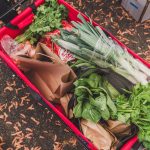
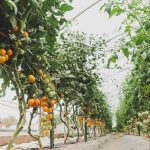
While you may know Deschutes Canyon Garlic for their varieties of seed garlic and garlic scapes, you may be surprised to learn that their primary crop is actually cover crops. These are plants grown during the off-rotation years—when garlic isn’t in the ground—to reduce erosion, build organic matter, and help manage disease and pests. Garlic is only grown on each acre once every five years.
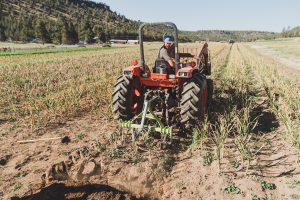 HDFFA staff sat down with Gia Matzinger, co-owner of Deschutes Canyon Garlic, to talk about their business, ethos, and approach to organic farming.
Gia and her husband, Jonathan Sattler, originally from California, first got their hands in the dirt through the Rogue Farm Corps apprenticeship program in Southern Oregon. The farm they apprenticed with had a small seed garlic operation, which later inspired the idea for their future farm. Afterward, they moved to Bend for a job in the outdoor industry.
Eager to dive deeper into farming again, they joined the UC Santa CruzCenter for Agroecology and Sustainable Food Systems program before leasing a farm in that area for three years. With dreams of moving back to Central Oregon, they eventually made their way back – knowing full well that farming here would mean learning a new climate and adapting their methods.

That’s when they homed in on their specialty: unique and flavorful varieties of certified organic seed garlic.
Their decision to grow garlic came after careful consideration of the local climate, soil conditions, and the agricultural history of the area. Central Oregon, it turns out, is uniquely suited for growing seed garlic. After experimenting with flower production, mixed vegetables, and running a CSA, they realized it was a lot to manage, and all of that was very hard on the body. Garlic just made sense.
In the early days, Gia and her husband farmed on a tiny scale, putting in a few hours a week while holding down day jobs. They started with just 1/6 of an acre and gradually expanded to the 8 acres of irrigable land that they currently farm on. It wasn’t until their third year that they produced enough to start selling.
Today, Deschutes Canyon Garlic offers seven garlic varieties available for presale on their website starting each July, and at farmers markets in Central Oregon based on seasonal availability. But what Gia seemed most excited about wasn’t the garlic itself, it was the cover cropping system they’ve built. With a five-year rotation and only 1/5 of their land growing garlic at any given time, Gia says it sometimes feels like they’re cover crop growers first: in other words, soil builders and pollinator and wildlife habitat developers. When asked, “if you were a product you sell or grow, what would you be?” she called out phacelia as having a special place in her heart. She described phacelia as a cover crop known for its attraction to pollinators that comes back quickly perennially, but it’s also known for its resilience; this feels especially fitting given their farm’s approach to sustainability and mindfulness of their land.
Certified organic farms must create what’s called an Organic Systems Plan. Gia emphasized that in California, organic certification carries real weight for the consumer, with suspicion of those claiming organic practices without the certification. She noted that while this feels less prevalent here in Central Oregon, they already valued organic practices so getting certified was a natural step. “It’s how we learned to farm,” Gia said. “The certification helps reinforce those values and provides a framework for low-impact, environmentally friendly practices.”

Their primary motivation is to be a part of the ecosystem they farm in. Gia shared that they aim to reduce the separation between farmland and wildlife habitat. Elk, cougars, badgers, deer, and all kinds of wildlife pass through their land. Rather than fencing it all off, they try to create space for those animals to exist. “We want to be a pathway, not a barrier,” she said. Farming this way has its challenges, but it aligns with their values. On a broader scale, Gia said, choosing organic also means opting out of industrial systems that harm the environment.
When asked about common misconceptions around organic farming, Gia noted that some people are skeptical of the organic label. In her view, this skepticism often stems from allowable inputs – like certain pesticides – that can still be used under organic certification. That tiny farm in rural Central Oregon and the mega-farm in the Midwest fall under the same certification, she noted. She shared that getting and maintaining certification is not an easy process, with a lot of back and forth; that said, it helps with keeping growers accountable. But if there was one thing she would change, it might be to have different standards for these different sizes of farms. As a small farm, she doesn’t need to use the pesticides allowed under the organic certification that a larger farm may need. This may make sense on a larger scale, but with their small operation can be challenging of labor and resources.
 Gia hopes that when people buy their garlic, they understand the life cycle of the crop and not just see it as something that magically appears in a grocery store year-round. “Everything has its peak freshness and exuberance and a moment when it’s just so, so good,” she said. “We do a lot to make it available throughout the season, but it’s important to appreciate that freshness.”
She also hopes consumers understand that not all farms and operations are the same, but they are “all just trying to make a living, and do it in an ethical way,” she said. As consumers, it can be difficult to see the minute differences, from motivations to microclimates, that influence each farm.
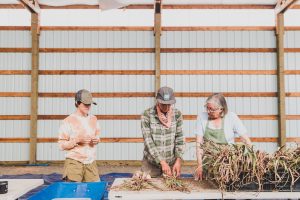
On the other hand, for farmers, it’s important to learn from and with other farmers and take the information that feels most impactful and applicable. Gia pointed to informal conversations with other farmers – often at the farmers market or when visiting another farm – as one of the most valuable tools to her to continue learning. “Talking to folks doing things on a similar scale with similar equipment and outlets, it’s huge,” she said. There’s also an OSU Extension grower email list, though it’s quieter these days. And while extension publications are a great starting point, Gia notes they often need to be adapted to small-scale or organic operations.
The biggest takeaway? Every farm is different. The growers, the land, the product – each operation is a unique combination of inputs. As a consumer – get to know your farmer: that’s how you start to understand the seasonality, the effort, and the care behind the food you buy.
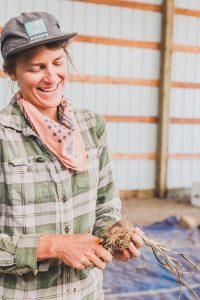
You can find Deschutes Canyon Garlic at farmers markets – including the Bend Farmers Market starting mid-June – and online starting in July for preorders. They partner with Central Oregon Locavore for volunteer WOOLF days, host the occasional gardening club or school visit, and try their best to accommodate tours for other growers interested in learning more about growing garlic or touring their operation.
Learn more about Deschutes Canyon Garlic on their website here. HDFFA is highlighting farms in Central Oregon that are organic, transitioning, or considering becoming certified organic to share their stories. Look for future features over this next year!
This project is funded by the USDA Northwest Transitioning to Organic Partnership Program. Learn more about NWTOPP, and the programming offered – including mentorship, community building, workforce development, and education – at the Oregon Tilth website here.